Wednesday, March 7, 2012

Rumah Stroberi


Rumah Stroberi

Today my friend Helen and I visited Rumah Stroberi (Strawberry House) in Lembang, north of Bandung for lunch and a chance to pick our own strawberries. The drive up itself was a feast for the eyes. The narrow but heavily traveled road was lined with huge nurseries on either side. Each was jam packed with blooming flowers, plants and trees of every variety imaginable!


strawberries grow in long rows inside containers


Picking berries usually conjures up visions of bending, mud, snakes and sunburn. But these berries are grown in long rows of individual containers inside hot houses. Like many other structures here in Indonesia, the hot houses are constructed of bamboo. To pick at Rumah Stroberi, one only has to show up, pick up a basket and a pair of small scissors and start snipping! Once you have all you want, workers take the berries and weigh and package them up neatly for the ride back.


one of thirteen bamboo hot houses


ripe for the picking


me with my basket filled
berries in various stages of growth


5 workers package up our berries
We are continually amazed  here at how many people there are working at the same job. We see this literally everywhere we go. I suppose this is due to an overabundance of people willing to work in low paying jobs. When we notice this, we always say to each other (under our breath of course) "how many does it take?" Today as Helen and I placed our berries on the counter to be weighed, there were 5 employees weighing and boxing them up.


where's the whipped cream?


After our strawberries were neatly boxed and bagged, we had lunch on the grounds. There was a package deal that included picking strawberries with lunch afterwards. It was the typical Indonesian fare, consisting of fried tempe, a chicken wing, rice, fried tofu, hot sauce and raw veggies. Like most of our meals here, it had a nice presentation but tasted very so-so.


the view from our table to terraced fields beyond


typical Indonesian meal (rice in banana leaf)


Rumah Stroberi got its start in 2002 when a local doctor and his wife started planting strawberries in Lembang, north of Bandung. What started out to be a family weekend escape has grown into a a tourist destination. After the first attempt at growing strawberries went so well, the  doctor and his wife started selling crushed strawberry juice at college events. As interest grew in the berries and drinks, their fields were opened to the public in 2003 so that people could pick their own. Within 5 years, their single greenhouse had expanded to thirteen. Now with the addition of a restaurant and other facilities, Rumah Stroberi has expanded into a successful enterprise employing many locals.


Tuesday, March 6, 2012

I just don't know what to do with myself...

baso for sale

Well, that is one statement that you will likely NOT hear from an Indonesian, at least not the ones who live in this city. I am constantly amazed at how busy these people are. Unlike so many large US cities where you tend to see homelessness in increasing numbers or men just hanging idly, Bandung residents don't really fit into either of those categories.


Even though your average Indonesian doesn't appear to have a lot, that doesn't prevent them from being industrious or hard working. We have jokingly said that if there's a way to make a rupiah, the Indonesians will find it. It's true and I really have to admire them for it. If I had no education and no skill but I needed to eat, what would I do? I'd have to think of something, and that's what these people do. I don't think anyone could ever accuse them of being lazy or unwilling to work. And they certainly don't have welfare checks to look forward to each month. No, if they want to eat they have to work, and work they do.


cooking coconut dessert on street
Indonesians come up with numerous ways to make a little bit of money. Of course many of them are involved in the making and selling of food on the streets. I couldn't even begin to guess how many gerobaks (rolling food carts) there are in this city, each serving up popular Indonesian street fare. These are quite literally everywhere you look!


But what if you can't afford to buy a gerobak to cook and sell your own food, what then? Well, many will still cook and sell their own food, but will carry it by balancing a cooking/serving vessel on either end of a wooden bar across one shoulder. They can be seen anywhere and everywhere - on heavily crowded streets or even walking the neighborhoods to sell their soup or meatballs or whatever they have made.

If they don't have such a set up, they will fry kerupuk which are fried crispy snacks (light like a rice cake but often fishy tasting) or some other "goodie" in their home and then work the street corners and intersections, peddling it to the cars in stopped traffic.


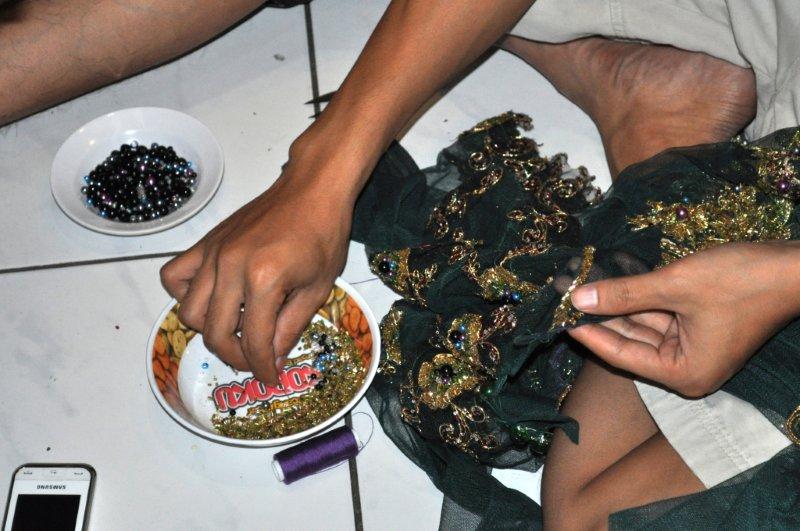
hand sewing beads one at a time in women's wear shop
In addition to the enormous and ever present food industry, there is always the service business. Those who are fortunate work as cooks, gardeners, maids, drivers, store clerks, gas station attendants, etc. But those who don't have steady employment or much in the way of resources still manage to find countless other ways to make money.


Some people learn skills, such as auto or scooter repair, furniture or birdcage making, sewing, shoe repair, metal work, etc.


cardboard recycler

Others who are less skilled are what I would politely call "recyclers." They drag large plastic bags from street to street, going through the constantly overflowing trash bins in search of plastic, cardboard or anything that can be sold. I think theirs is the hardest job of all.


scouring through rotting trash
 
There are also self-appointed parking lot attendants who help drivers manipulate tight spots and street/traffic directors who stop traffic to allow people to turn across traffic, for a small fee of course.

Others sell on the streets, either from the sidewalks or working through the traffic. They sell t-shirts, rat traps, fake hair, Sponge Bob Square Pants, trinkets, magazines,  cigarettes and much more. You name it, they sell it.


Sponge Bob toys for sale in traffic
And let's not forget the street entertainers. These consists mainly of musicians (traditional Indonesian instruments, guitars and ukeleles) or trained monkeys riding bicycles or jumping through hoops.They do what they do for loose change.

Pretty much every able bodied Indonesian is at work during waking hours, either taking care of children or trying to make a rupiah. The blind or lame must resort to begging, either by working the traffic (with help) or simply sitting or lying on the sidewalk with a cup.
rain gear for sale - very important during rainy season


this rainy day entrepreneur seized the opportunity to escort shoppers to the angkot (for a small fee)
buy a duck puppet, please?


sighted man leads blind man through traffic


Monday, March 5, 2012

The Asian Squat?

I sometimes wonder what foreigners find strange about Americans when they come to the US. I'm sure whatever it is, it's most likely something we don't even notice about ourselves. I think the same in true when we as Americans visit other countries. We notice even small things that to us may seem a bit peculiar, while the people of that culture think nothing of them whatsoever.


For example, one thing I noticed the first time we went to China was the way Asians squat. They can be doing nothing at all, and they apparently are more comfortable in a squatting position than they are standing. Maybe it's because I'm getting old and am not all that limber, but squatting to me is not what I would consider a comfortable position to spend time in. I'm not sure why Asians find this position so comfortable, but we see it literally everywhere. Of course Asians in general are very thin but I still am not sure why they enjoy resting in a squatted position. I've noticed that even children do this and women too, though less often than men.


Almost every man that is not working can be seen in a squatted position. I feel quite certain that this is something Asians do without a lot of conscious thought. In addition to squatting, almost every Indonesian male smokes cigarettes. So the only thing I see more often than men squatting, is men squatting with a cigarette in hand.

While I realize this topic is not exciting or perhaps even all that interesting, it's just something that I can't help but notice - a lot. I mean, when is the last time you saw an American man squat? I'm not saying that they can't or never do, but it's not a common sight in the US like it is in Asia. I also find myself wondering what other things they do that would seem strange to us (if we knew), as well as what things we do that would seem strange to them? Hmm...


Sunday, March 4, 2012

Mommies and Nannies


young mom carrying infant

There are LOTS of babies in Indonesia! Yet believe it or not, I honestly cannot remember seeing or hearing one cry. But then what do they have to cry about anyway? Most of them seem very content to be carried along, snugly conformed against their mother or nanny's warm body. Theirs is the life. 

Nannies are very common here in Indonesia. From what I have read, even the middle class hires household help, ranging from nanny (pengasuh anak), general helper (pembantu), driver to gardener. Though nannies are common, I suspect that most of the women I see walking the streets on a daily basis are carrying their own babies.


side view of selendang

babies always appear content


Indonesian nanny, Chinese mother
But for the middle class and up, it is not uncommon to employ helpers to “serve” in different capacities. In fact, these helpers are often referred to as “servants.” One thing we quickly became aware of shortly after coming here is the “class thing.” Specifically, the Chinese generally tend to be much better off financially than the Indonesians; thus Indonesians must work for Chinese. It was shocking for me the first time I observed our Chinese landlady interacting with our Indonesian cleaning lady. In a word, I was mortified! It was also very obvious that our former driver (Indonesian) very much disliked Chinese in general,  and made no apologies for it. So we have definitely felt some tension.


young Chinese couple with Indonesian nanny
Given the above, it is extremely common to see Chinese parents using Indonesian nannies, especially in the large malls or in nicer parts of the city. Having just returned from Jakarta where there are several over-the-top exclusive malls, we observed it literally everywhere we looked!  Indonesian nannies usually dress in pale pink, pale blue or white uniforms and can be seen tagging a few feet behind a young Chinese mother, while carrying the baby, diaper bag or both.


same combo
According to the expat website (below), most of these Indonesian nannies probably have only elementary or junior high education, though a few will have completed high school. Sometimes their duties include house work, cooking and laundry in addition to child care but often their primary responsibility is to care for the children. It is obvious when walking in the malls that some of the wealthier families employ one nanny per child.

I also learned that Indonesians tend to be much more lenient that westerners with discipline. Nannies in particular love to spoil babies and let them have anything they want. Notice from the photos that mothers/nannies usually carry babies in a long scarf (selendang) rather than pushing them in strollers or letting them walk. I was surprised to learn that most Indonesian babies skip the crawling stage because of the habit of carrying them through their early toddler years.


1 family, 3 children, 3 nannies

In the months since coming to Indonesia, I have never seen a baby stroller except inside a mall. I suspect that is because there are no sidewalks here with an even surface. Additionally, strollers cost money and take up space. Thus, the selendang. For more information on nannies, check out what I found on this expat website below.


nanny carrying baby in left hand, pushing stroller with right

So what do these nannies earn for all their help? Though I have "zero" firsthand experience with nannies, some simple web searches reveal that Indonesian nannies can make anywhere from 1 million rupiah to 1.5 million rupiah per month (6 days a week). That translates to anywhere between $110 - $165 per month.


Friday, March 2, 2012

Making of an Angklung


I’ll admit that I had never heard of an angklung before coming to Indonesia. The angklung is a traditional musical instrument made of bamboo, originating here in Indonesia and popular throughout southeast Asia. Angklungs come in many sizes - from very small to very large. Each angklung consists of 2 bamboo tubes attached to a bamboo frame.

angklungs for every size and budget
The tubes are carved to make a certain pitch when struck and are tuned to octaves. The base of the frame is held in one hand, while the other hand shakes the instrument rapidly. This causes a repeating note to sound. Each angklung plays a single note. When angklungs are played in a specific order, they actually make melodies that sound quite nice! I’ve attended 2 angklung performances since coming to Bandung, and have learned to appreciate their sound, although I’m still probably not ready to buy an angklung CD! Angklungs are also easy to learn to play and a lot of fun too!

I read somewhere that the oldest surviving angklung is 400 years old. A museum here in Bandung houses a number of antique angklungs. Even though bamboo is light in weight, it is very strong. It also grows easily here, making it in plentiful supply.


The late Udjo Ngalagena founded an art center here in Bandung for the purpose of art performance and education. Many children in Indonesia learn to play the angklung while still very young. Some of its advantages are that it’s easy to play, inexpensive to purchase and actually fun.


Ronnie & Jan at Saung Angklung Udjo


Below is a link to Saung Angklung Udjo where you can hear traditional Indonesian songs being played on the angklung and other bamboo instruments by children of various ages. You can also see the workshop at the very end of the clip where the above photos were taken.


Thursday, March 1, 2012

A Train Ride to Jakarta

Actually, we could have had Ferry (our driver) bring us here, but riding the train to Jakarta is something I’ve wanted to do almost since we arrived. I had heard that some of the scenery was really beautiful and I knew I would see rice fields and other things that I would not see flying along the freeway at high speed. I was not disappointed. The train itself wasn’t bad – a little old and not very clean, but still comfortable. We upgraded to First Class (with AC) and it was still under $7 each. Not bad, eh? The windows were quite dirty, but I was able to find an area at the back of our car where I could stand and catch some shots through a larger (and cleaner) window.


villagers walking behind homes


When riding a train and passing through these small towns, you’re basically riding through people’s back yards. Of course it’s not your wealthiest people who live near the tracks so we saw a lot of poverty there. We saw everything - reasonable looking homes as well as shanties. We also saw Indonesians going about their everyday lives. I think collectively we observed people doing just about everything people can do. Seriously. We saw women washing clothes in a flowing stream, men relieving themselves, women feeding babies, people tending goats, driving motor scooters, burying the dead, bathing, sleeping, cooking, eating, buying, selling, threshing rice and pretty much anything else you can think of as we rumbled through the villages. It was an interesting ride and parts of the scenery were exceptional. We also saw more trash than I hope to ever see again.


all too common trash scene


motors wait at train crossing


off the dirt road


rice farmer at work


Our ride lasted a little over 3 hours and delivered us into Jakarta Station where dozens of cabs were waiting outside. One of our discoveries here is that Indonesians will come up with any and every way possible to make a rupiah. As soon as the train pulled to a stop, men who had never even heard of deodorant surrounded us, each hoping to be the one to get to carry our bags off the train. We made our way to a long row of waiting cabs and held our ground for a Blue Bird (a reputable company) though our luggage had already been put into another company’s cab. A half hour later we were at the Pullman, and pleased as punch to be here.


working in the rice paddies


woman drying rice by railroad track


community clothes line

children at play

Enjoy some of the photos taken from the train ride between Bandung and Jakarta, Indonesia on this first day of March, 2012.


flooding rice paddies


beautiful rice fields


terraced landscape for rice growing


field worker bringing in rice


gorgeous green rice fields


young rice coming up (bottom)


stirring rice to speed its drying


highway to Jakarta


more terraced rice fields